Plug in your stack
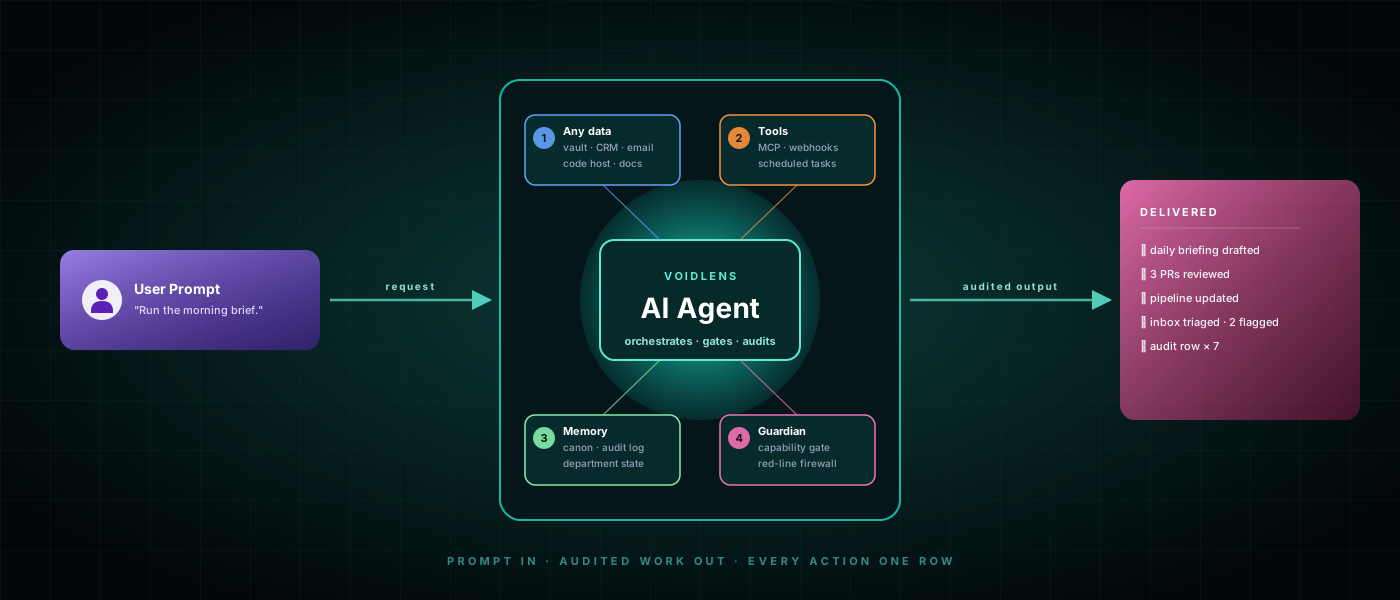
MCP connectors light up the departments — Slack, Gmail, Linear, Stripe, your CMS, your warehouse. Each capability gets registered and rate-limited.
VoidLens is the supervisor seat for your autonomous AI workforce — seven departments, forty-eight-hour ladders before any new capability ships, and every action audited. The dashboard, the audit reader, the approval queue, the autonomy ladder — all in one lens.
We stopped writing prompts and started writing specs. Three of our internal automations went from "engineer babysits this" to "engineer reviews the audit log on Friday." The 48-hour shadow window caught two regressions before they touched production.
20-second loop, no audio — coming with launch.
I spent nineteen years moving freight — nine in the Army across two combat tours, specializing in convoy operations and logistics management at scale, then a decade on the civilian side coordinating fleets, brokers, customers, and the dozen edge cases nobody writes down. The pattern is always the same: the work scales linearly with people, and the people get tired before the work does.
Agentic AI flipped that. For the first time, a department can grow capacity without growing headcount — but only if you can trust the workers you can't see. That's the gap VoidLens fills. Every action audited. Every new capability lives 48 hours in shadow before it ships. Red lines that nothing — not even me — can override.
Run AI like a company. Not a chatbot. Not because the slogan is clever, but because anything less and you have either a toy or a liability.
The advisory-AI era is over. The 2026 frontier is AI that senses, decides, and securely acts. VoidLens is the kernel for building one of those — an autonomous AI company with the safety rails of a real engineering org built in from message one.
Engineering, Marketing, Operations, Revenue, Customer, Finance, and the Daemon watchdog. Each owns a lane. Each has a worker.md, a playbook, capabilities, and a budget.
No agent jumps straight to full autonomy. Every capability earns its way from L0 read-only → L1 propose → L2 act-with-review → L3 act, through a clean 48-hour shadow window.
Every non-trivial action is one row in state/audit.jsonl — cost, duration, outcome, reason, playbook version. You can read what the company did, why, and what it cost. To the cent.
I'm a logistics operator first. Nine years in the Army across two combat tours — convoy operations and logistics management at scale — then a decade running civilian-side logistics: dispatch, fleet, freight, the daily mechanics of moving real things through real systems on real deadlines. VoidLens is the AI workforce I built for that operator: seven departments, a forty-eight-hour ladder before any new capability ships, every action audited to the cent.
I built it fast because I already knew what I needed from it. The advisory-AI era is over and the chatbot-as-product wave skipped the safety story I'd want before I'd let any of this near my own customers. The five rails aren't marketing copy — they are how my own company runs every day, and the audit log is the receipt.
VoidLens is the dashboard, the audit reader, the approval queue, and the autonomy ladder, all in one. Plug it into your stack and Voidlens runs your knowledge work while you review.

You don't write prompts. You hand work over to a department and review what comes back. The 48-hour ladder takes care of the rest.
MCP connectors light up the departments — Slack, Gmail, Linear, Stripe, your CMS, your warehouse. Each capability gets registered and rate-limited.
Drop a task into VoidLens. The router picks the right department. The agent reads the playbook, asks Guardian for permission, and acts (or shadows).
Every action is one auditable row. Costs roll up. The autonomy ladder advances. You approve the proposals. Nothing surprises you.
VoidLens runs on two cooperating brains. Claude is the frontier reasoner for hard decisions. Ollama is the local secondary brain for cheap inference, smoketests, and the moments your network — or your provider — goes dark. The router picks the right one per task and per budget.
For anything that requires real planning, judgment, code, contracts, or customer-facing copy. Capability-gated, audit-logged, cost-tracked to the cent.
Llama3 running on your own hardware. Free, private, and always there. The router routes cheap-and-cheerful work here and uses it as the live heartbeat for smoketests, classifiers, and offline fallback.
Every routing decision is one audit row. You see which brain handled which task, what it cost, and why the router picked it. The 10-minute Ollama smoketest is your heartbeat — if the local brain ever stops responding, the dashboard goes YELLOW before any agent notices.
Not 50 disconnected bots. Seven departments, each with a worker profile, a playbook, a capability allowlist, a daily budget cap. Customer-meaningful, not investor-lingo.
Debug guardrails, design queue, deploys, evals.
Brand steward, content publisher, market scout, media.
Inbox triage, archives, docs-pusher, MSAs, security questionnaires.
Revenue stream, offer builder, enterprise AM, customer ops.
Customer success, escalation queue, ticket triage.
CFO controller, budget watcher, billing watcher.
Void-doctor, void-surgeon, orchestrator, void-pulse, compliance.
Drag to orbit. Click a sphere to focus a department. Every node is a real agent in our v0.1 build with a spec, a playbook, and a capability envelope.
Cinematic flythrough plays on load. Drag to orbit · scroll to zoom · click any satellite for the lane detail and live activity · keys 1–7 jump straight to a department.
Numbers from the V1 instance, refreshed every minute via the live-snapshot emitter. This is the same architecture that powers the audit reader.
Snapshot timestamp: 2026-05-18T22:13Z
· V1 HEAD: 58ecd69
· Refreshed every 60 seconds in production.
Five rails sit underneath every agent. They are not flags you can disable. They are immutable. They are why your compliance team will sign.
Every destructive or external action passes through Guardian's allowlist. The forbidden list — payments, hard-deletes, unapproved web submits — cannot be overridden by any agent prompt, any time, ever.
Every agent is a contract first. spec.json, worker.md, playbook.md, evals/eval-set.yaml. The code is the receipt of the spec. You can read the contract before the agent ships.
One canonical row per non-trivial action: timestamp, run_id, agent, action, target, outcome, cost, duration, reason, playbook, playbook_version. Nothing is silent.
No agent climbs the autonomy ladder without a clean 48-hour window of read-only or propose-only firing. Any miss, any red-line touch, any unbudgeted spend resets the clock.
Behavior change ships against an eval set. Online sample too. Pass-rate below threshold blocks the promotion. The gate is mechanical, not vibes.
Daily cost cap per agent. Per-action rate limits. Fan-out budgets. The system halts cleanly before it overspends. Founder gets a one-line YELLOW before it ever turns RED.
Every agent climbs L0 → L1 → L2 → L3 through a mechanical 48-hour shadow window. Any miss, any red-line touch, any unbudgeted spend resets the clock. This is not a process. It is a contract with you and your compliance team.
capabilities_forbidden_always list is immutable. No autonomy bump, no Board vote, no operator override removes them.
See the red lines →
We price on capability volume and budget, not headcount. Bring your own model keys, or use ours.
ChatGPT is an advisor. VoidLens is a labor force. ChatGPT answers questions in a chat window — you still have to do the work. VoidLens runs the work: an agent reads the playbook, asks Guardian for permission, executes inside its capability envelope, and emits an audit row. Each agent specializes in a department, has a budget, and climbs an autonomy ladder. You supervise, you don't prompt.
It replaces toil, not judgment. The autonomy ladder is explicit about this: L2 agents propose, humans approve. L3 agents act for low-risk classes. Anything that touches money, contracts, or your customers stays at L2 by default — and red lines are immutable, no agent ever crosses them. The people you have shift up the value chain.
Five rails: Guardian-gated capabilities, spec-before-code, audit-every-action, 48-hour shadow, eval-driven deployment. The forbidden list (payments, hard-deletes, unapproved publishes) is hard-coded — no agent prompt, no founder override, can disable them. We treat the safety story as the product, not a footnote.
Operator tier: your data stays in your connected systems (Slack, Drive, GitHub, etc.). Inference goes to your chosen model provider (Anthropic or OpenAI by default; bring your own keys). Enterprise tier: VPC deploy with HMAC-signed keyring, on-prem option, SOC 2 in flight (2026 target).
Day 1: plug in two connectors, watch one department shadow-fire. Week 1: approve the first L1 promotion. Week 2: first L2 agent proposes real work. Month 1: a department is meaningfully reducing toil on a measurable metric. Founder pilot today is at 60% to ready — we open the program at 80%.
The Operator tier at $499/mo covers a 5-15 person team running all seven departments at moderate volume. Heavier usage rolls into Enterprise. The Founder tier is genuinely free — no credit card, no time limit, just capped budget and 3 departments to start.